

Saddle for transportation of goods
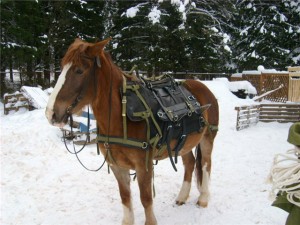
Transportation of tourist equipment is often complicated by the peculiarities of the route. And riding on a horse becomes senseless when one may travel by a car.
Travel load (tents, food, personal items, medicine, dishes and so on) can be transported on horses in two ways: you may divide the whole baggage among your group members or convey the items of general use on special packhorses.
For the transportation of personal items on saddle-horses one may use saddle-bags and pack straps. A pack horse is able to go a way of a pedestrian.
Pack horses are, as a rule, of a medium size, not higher than 150 cm at withers, with a long body, strong chest, back and hooves.
For exploiting pack animals effectively the appliances such as pack saddles have been used for a long time. It may be simply a sack with granular or soft goods in it, thrown over the horse’s back.
The standard set of the pack ammunition includes: headband, pack saddle, pack appliances and adjusters.
The example is on the photo.

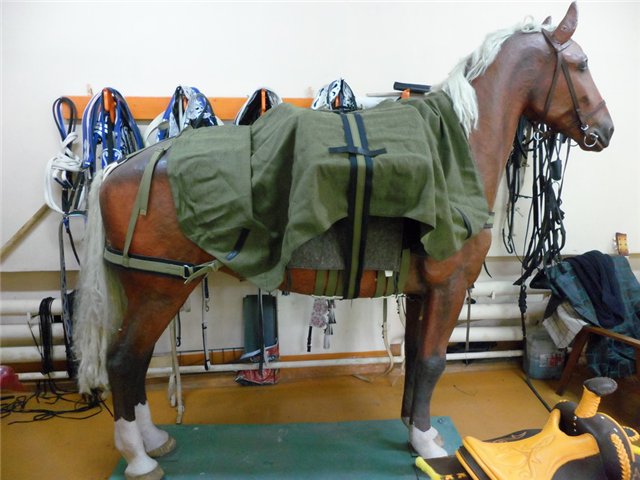
The pack saddle has some meaningful peculiarities. There are appliances providing tough adjunction of the saddle and the horse’s body, attached to the saddle. They are: breast-band, rear harness, wide girths, sweat-cloth and adjustments for pack attachment.
Have a look on the example.

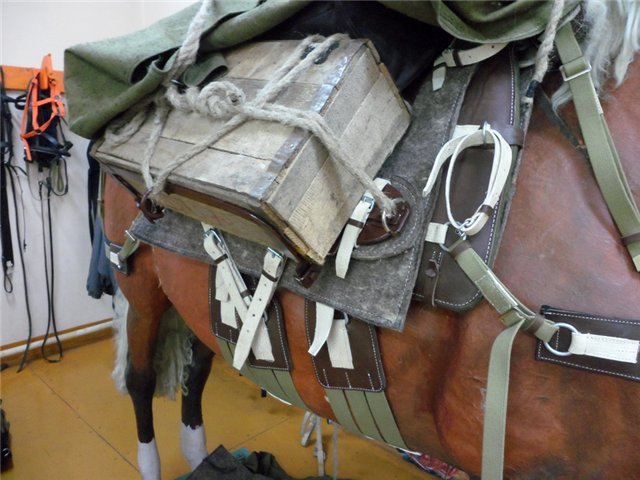
The load for transportation should be arranged into three packs: top, right and left.
There is a main principle of loading a horse: the weight of a right and of a left pack should be equal.
A generally accepted opinion exists that a horse is able to carry the load on its back that equals approximately one third of its weight, a mule can carry a half of its weight, and a donkey – two thirds. However, these data shouldn’t be taken as true and constant in all conditions and for every type of pack animals. A pack horse is able to carry the load of one third of its weight only on a comparatively flat area and walking at a slow pace. When the conditions change, for example, on steep slopes, at high altitude or when the pace of movement increases the carrying capacity of such animals reduces. One should locate the cargo in a pack so that one fourth of it to be on the back and three fourths to be from the sides. All the cargoes should be thoroughly fixed for the shift not to exhaust or hurt an animal.
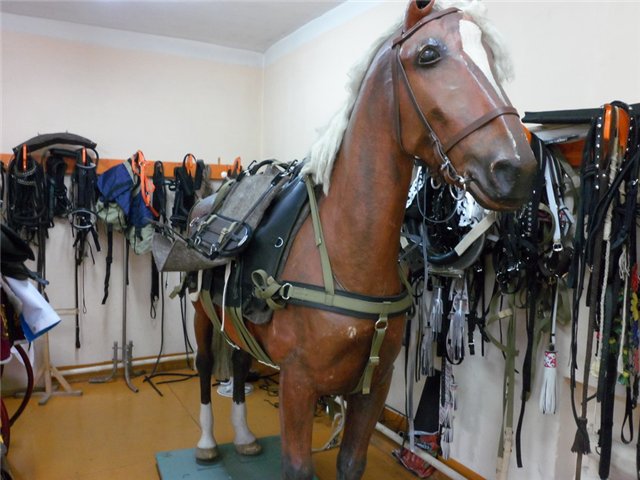
Horses must rest during halts. When the rest stops are short (10-15 minutes) they should be obligatory unsaddled, and the fixation is rearranged and corrected. During long rest stops (not less than two times a day) horses are fed, watered and not disturbed.
The basic saddle-set includes:
1)Bridle-halter;
2)Saddle-tree;
3)Small front pads, left and right;
4)Large pads, left and right;
5)Neck pad;
6)Girth band;
7)Supporting girth belts;
8)Felt sweat-cloth;
9)Chest band harness;
10)Back band harness;
11)Undertail band;
12)Fixing belts for chest and back harness;
13)Girth front belts and back raw belts;
14)Surcingle roundabout band;
15)Underchest belt;
16)Pack belts;
17)Tarpaulin;
18)Extra girth;
19)Left and right frame;
20)Underframe lining;
21)Fixing ropes.
At the requests of huntsmen and hunter tourist camps we have begun to produce a new line of saddles for chase.